AI for Logistics and Distribution
The email that becomes a load, and the freight paperwork that becomes a record, without anybody retyping either.
What this is for a freight or distribution business
Freight work arrives as prose and paper. A rate confirmation in an inbox, a bill of lading photographed at the dock, a proof of delivery, a carrier invoice that has to be checked against what was agreed. Somebody reads each one and types it into a system that already knows most of it.
The work here reads those documents into the transport or warehouse system and turns the inbound message traffic into records instead of retyping. It runs in a cloud account the business owns, with every run logged and every failure raised.
The scope is set one document type or one message class at a time. That is the discipline that makes these finish, and it is why the first one is usually live in weeks.
What you get
What gets built
One trigger and one path first, widened after it is trusted.
Rate confirmations into the system
Lane, dates, equipment, references and the agreed rate read into fields and written to the load. Anything the system is unsure about is queued for a person rather than guessed.
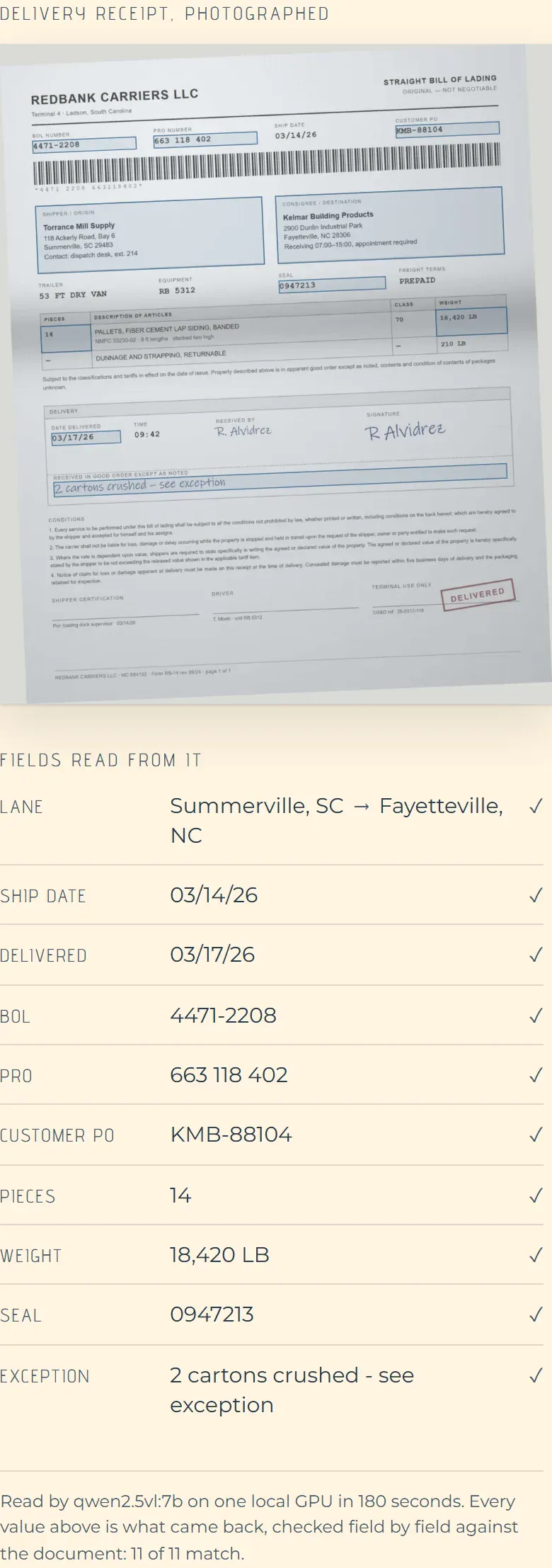
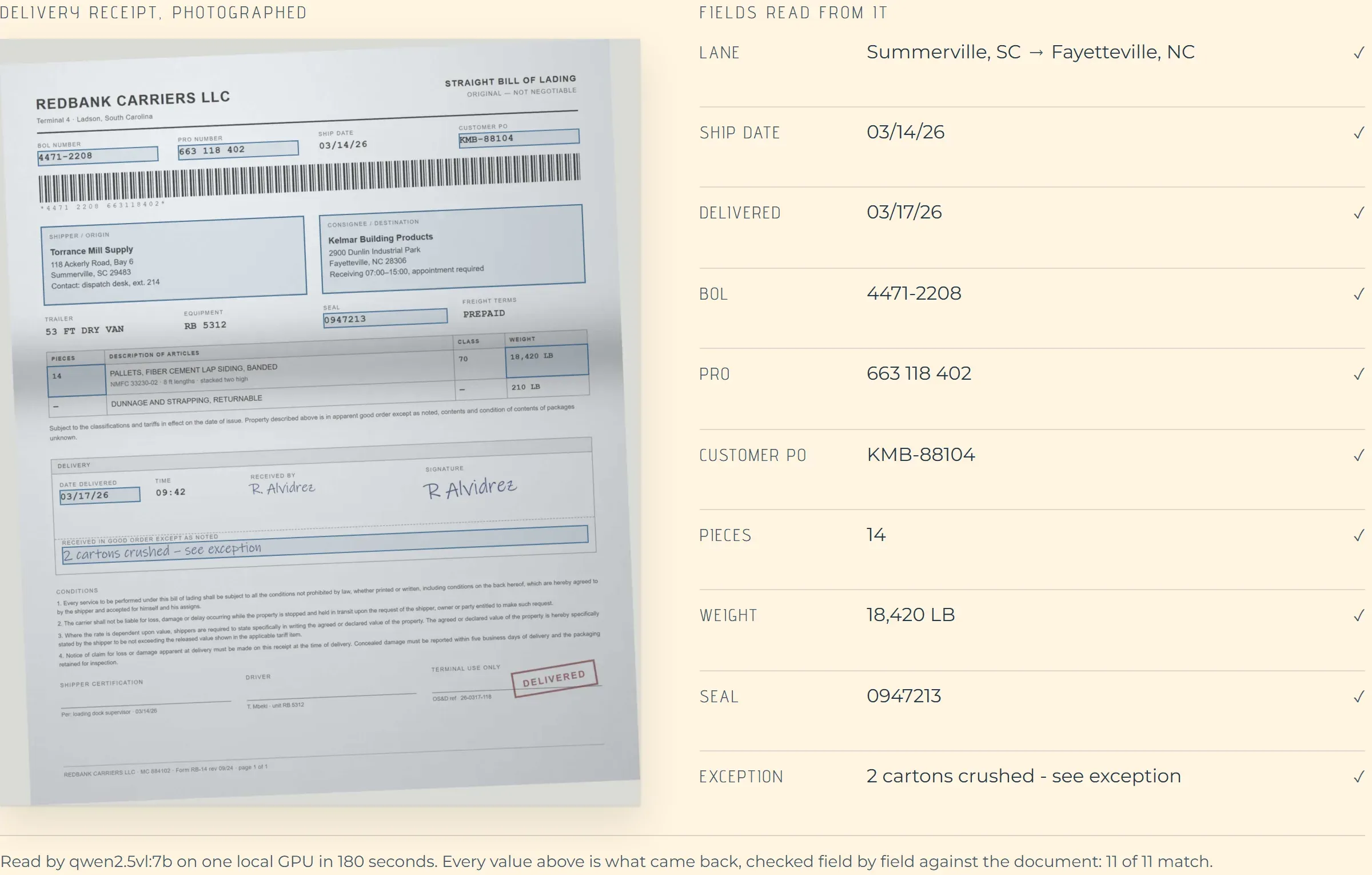
Bills of lading and proof of delivery
Photographed at the dock or scanned at the desk, read into the load record and filed against the right shipment. Signed and stamped copies are part of the sample it gets tested on.
Carrier invoices checked against what was agreed
Invoice values extracted and compared with the rate confirmation and the accessorials on file, producing a queue of exceptions rather than a pile to audit by hand.
Inbound email turned into a load
Orders and tenders arriving as prose read for lane, dates, weight and references, then written into the system of record with anything ambiguous flagged.
Status requests answered
The where-is-my-freight question answered from the tracking data, with anything unusual passed to a person rather than guessed at. It is the highest-volume message class in most brokerages and the least valuable use of a dispatcher.
Carrier onboarding paperwork
Authority, insurance certificates and tax forms read into the carrier record, with expiry dates tracked and the chase sent automatically before they lapse. The packet arrives in a different shape from every carrier, which is exactly the case extraction is for.
The daily and weekly reporting
Exception reports, dock schedules and customer summaries assembled from the systems that hold them and sent on schedule. It says so when a source has not updated, instead of sending a report built on yesterday's numbers.
Somebody who owns it afterwards
Model versions, extraction accuracy and spend reviewed on a set cadence once the build is done. Freight volume moves seasonally and the automation has to be watched through it.
How it works
How the work runs
Pick one document or one message class
Rate confirmations, or delivery paperwork, or the status question. One at a time, because that is what keeps the scope finite and the build short.
Read the real inbox
Actual messages and actual documents, including the forwarded thread with four replies stacked above the detail that matters.
Build it narrow
One trigger, one path, running against live traffic with a person checking every record before it reaches the system.
Widen it once it is trusted
Exceptions get added after the main path is running, not before. That order is what separates an automation that lasts from one that gets switched off.
What matters
What decides whether a freight automation survives
Automations are easy to demonstrate and hard to keep running. In freight these are the reasons.
One shipment carries four different numbers
A load has a customer reference, a carrier pro number, a purchase order and an internal ID. Matching a document to the right shipment is usually harder than reading the document, and it is where most of the build time goes.
Running it twice must be safe
The same email arrives forwarded and the same delivery note is scanned at both ends. Anything that writes to the transport system is built to tolerate that without creating a duplicate load or a duplicate invoice.
Silent failure is the failure mode
An automation that stops working rarely announces it. Run monitoring and alerting are part of the build rather than an extra, because a stopped automation looks exactly like a quiet day.
Exceptions are most of the work
The clean tender takes a day. The value is in what happens when a field is missing, an accessorial appears, or a system is down at two in the morning. Those paths get built deliberately rather than discovered in production.
Credentials are the real asset
An automation platform holds standing access to the transport system, the mail system and the file store — broader rights than any one dispatcher. Where that store lives and who can reach it is a design decision, not an afterthought.
Spend is metered per request
Cost tracks message and document volume rather than seats, so the build includes reporting on which customers and lanes generate the traffic. Freight volume moves, and the bill moves with it.
Who it is for
Who this is for
Brokerages and third-party logistics
Where the inbox is the order system and somebody retypes it into the transport system all day. The time from a tender arriving to it being accepted is the number worth measuring.
Carriers and drayage operators
Port paperwork, delivery documents and driver-submitted photographs, in volume and at every hour. Charleston runs on a schedule that does not match office hours.
Warehousing and distribution
Receiving documents, packing lists and customer paperwork that has to become a record before anything moves off the dock.
Distributors with a quoting desk
Requests arriving as prose that somebody prices and re-enters by hand, usually while the customer waits.
Questions
Frequently asked questions
Will it write into our TMS?
The write-back is built against whichever system holds the loads. Where a supported interface exists it is used; where one does not, records are delivered in the format the system imports.
What happens when it is unsure?
The record is queued for a person with the original message beside it. The design produces a reviewed queue, which is what makes it safe to run against live freight.
Can it read a photograph of a delivery note?
Yes, and that is what it gets tested on. Dock photographs with glare, folds and a thumb over the corner are part of the sample the accuracy figure is measured against.
Does it run overnight, and what happens if it breaks?
It runs whenever the traffic arrives, so documents landing outside office hours are processed and the queue is waiting in the morning. Runs are logged and failures raise an alert rather than stopping quietly, which is the difference between an automation that lasts and one that gets switched off.
Do we still need EDI?
EDI stays where it works. This handles the traffic that never made it onto EDI — the email, the PDF attachment and the photograph — which at most brokerages is the majority of it.
How long does a first build take?
One document type or one message class is normally three to six weeks, most of which goes into the exceptions rather than the clean path.
Also on this site
Name the email that gets retyped
The tender, the rate confirmation, the status request. Whichever one arrives most.
(844) 422-7000