No central station monitoring
Owners self-monitor hardware directly with no central station. Operations do not function as a monitored alarm service and carry no UL alarm certificate.

Managed IT installations
Gates, fence lines, docks and yards covered by one recording system on site, installed across the coast from Charleston to Savannah.
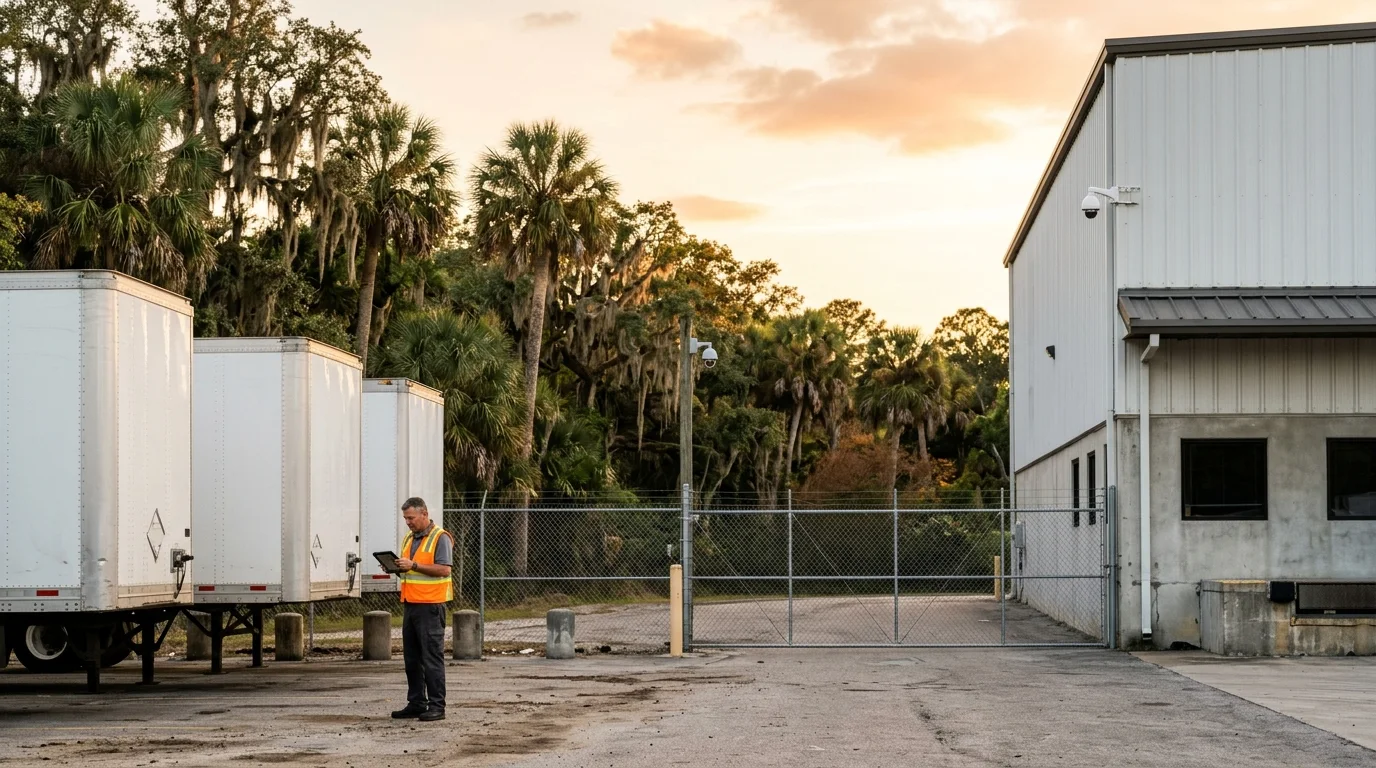
Recording on site
Cameras run on local recorders carrying no per-camera license fee, so recording, AI detection and remote viewing work as camera counts follow site requirements.
Video writes to hardware inside buildings, so recording continues securely even if internet connections fail.
Cameras sit on isolated VLAN setups, separated entirely from plant OT control networks.
One interface connects every camera, allowing managers to view feeds and search events from phones.
Every site needs specific camera mixes and network links to cover remote corners, shipping lanes and critical control rooms.
Site overview
Common requirements
Each location gets mapped for coverage and connectivity, placing precise lenses on targets and linking far poles back to buildings.
Click a position
Covers
Does
Connected by
Equipment
Layout shown is an example
Footage filters down to people, vehicles and plates, while alerts build from a specific trigger, a scope of cameras and an action.


Plate cameras read vehicles moving up to 90 km/h. To capture clean reads day and night, lenses must sit close to plates at shallow angles, supported by context cameras for general views.
Mounting height limits to 5 m, with capture distances of 12 m and angles under 25 degrees, or under 15 degrees for high-speed capture.
Glare-cut filters in LPR Night Vision show only plates and headlights at night, so a second context camera is added to cover general views.
Plate reads are entirely searchable in camera software, and managers can build plate lists that open gates for approved vehicles automatically.

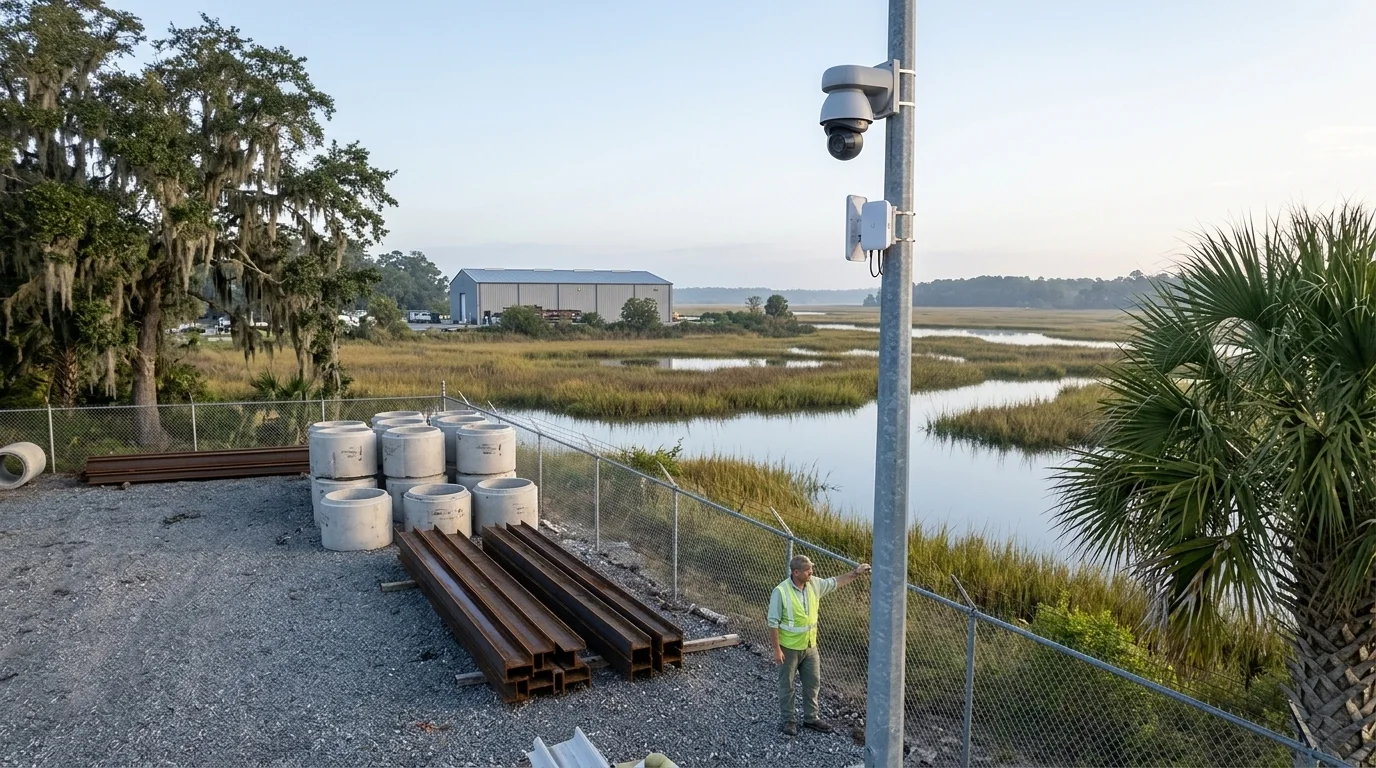
Remote corners and distant utility stations connect back to central recorders when trenching proves impractical, using long-range radio links and industrial LTE routers.
Bridges link remote camera poles up to 5 km away, passing PoE power directly to cameras at far ends.
Building-to-building 60 GHz bridges connect structures up to 500 m apart at 6 Gbps, featuring 5 GHz backup radios for heavy rain.
Cellular routers link remote yards lacking wired internet, recording footage to main sites centrally through Teleport setups.
Cameras run on one PoE cable each that carries power and video, and camera switches, bridges and routers are matched to the site.
Owners self-monitor hardware directly with no central station. Operations do not function as a monitored alarm service and carry no UL alarm certificate.
Equipment carries no hazardous-location rating. Cameras and switches go strictly in unclassified areas and never in fuel, dust or chemical classified areas.
Plate cameras at night show only plates and headlights due to filter settings, requiring a second context camera to cover general views.
Walk physical site footprints and shipping lanes to understand layouts and sightlines.
Map camera positions, poles and exact paths of each cable or wireless link.
Install and aim hardware directly with recorders to set focus and coverage angles.
Hand over systems with apps installed on managers' phones and alert rules fully set.
Footage is written to a recorder inside buildings, so recording continues securely on local hardware if internet connections fail.
Cameras sit on isolated VLAN setups, completely separated from plant control networks.
Wireless bridges link camera poles up to 5 km away and pass PoE directly to cameras when trenching proves impractical.
Cameras at remote sites can record securely to a central recorder through Teleport, requiring no local recorder on site.
Dedicated settings turn on a glare-cut filter for reflective plates at night, allowing cameras to read plates on moving vehicles clearly.
Camera software carries no per-camera license fee, so recording, AI detection and remote viewing work freely at any camera count.
CloudCentric installs camera systems at plants, yards, docks and water stations between Charleston and Savannah.