Where enterprise agent programmes stand, and the scope of this paper
Enterprise adoption and value realization
Large organizations scaling AI agents in at least one function rose from 27% to 40% in a year, while the share of organizations reporting any enterprise-level EBIT impact from AI stayed at 37%1. Companies abandoning most of their AI initiatives before production rose from 17% to 42%, and the average organization scrapped 46% of proofs of concept2. Gartner expects over 40% of agentic AI projects to be cancelled by the end of 2027, citing escalating costs, unclear business value and inadequate risk controls3. MIT NANDA's preliminary 2025 report found 5% of organizations got custom generative AI tools into production4. Because 80% never piloted one, the failure rate among organizations that did pilot is closer to three in four than the widely quoted 95%5.
Defining the enterprise AI agent
An AI agent is a language model that can call defined operations in business systems as well as generate text. These operations include reading records, drafting transactions, running checks and requesting approvals. Unlike simple chatbots that only generate conversational responses, an agent interacts directly with underlying business software to execute steps within a workflow.
Scope of this paper
This white paper examines why agent programmes stall and what the organizations producing value do differently. It sets out what makes an agent productive, covering retrieval versus fine-tuning, system operations and continuous evaluation. It details identity and data access architecture for agents, including delegation models and permission boundaries. It addresses bounding what an agent may do, focusing on incident patterns, excessive agency, control enforcement in software systems, approval workflows and cost management. It covers monitoring agents in production, assurance through red teaming and regression testing, governance frameworks, ownership models and a seven-stage enterprise rollout sequence.
I constructed a reference build on Microsoft Azure, run against two demonstration line-of-business systems with synthetic data, to illustrate several of these controls.
Anatomy of a working agent
An off-the-shelf model, plus four things the company supplies
Operations
24 operations over MCPget_job · get_prices · create_change_order · hold_invoice · book_vendor · request_owner_approvalData
317 company recordsAzure AI Search: keyword, vector and semantic ranking over price books, checklists, policies and past invoicesInstructions
Written work rules"Price only from company records." "Never change a supplier's bank details on the strength of an email."Output
Structured screensDraft change orders, held invoices and queued replies wait for reviewThe model
GPT-5 miniAzure AI Foundry · no custom trainingBarriers to value and characteristics of high performers
Causes the research names
Research indicates that a primary barrier to realizing enterprise value is a learning gap where tools fail to retain feedback, adapt to context, or improve over time4. Many programs suffer from brittle workflows and a misalignment between agent capabilities and daily operations4. Gartner names costs, unclear value and risk controls as causes of cancellation3. Approximately 20% of organizations report that AI operating costs, including token consumption, constrained their use of the technology1. A common strategic error involves positioning use cases as agentic when they do not require an agent to function3.
Practices of high performers
Organizations that extract value from AI agents differentiate themselves through workflow design and rigorous measurement. Nearly three-quarters of AI high performers fundamentally redesigned their business workflows1. This contrasts with only one-quarter of other organizations1. High performers are twice as likely to have defined processes to measure the impact of their deployments1. High performers are more likely to have defined processes for when model outputs need human validation6.
Deciding where an agent belongs
The Microsoft Cloud Adoption Framework provides a specific hierarchy for selecting the appropriate technical implementation. Organizations should use code or traditional automation for fixed steps7. Retrieval is the recommended method for obtaining answers from organizational knowledge7. Agents are reserved for scenarios where AI must reason about information and decide or coordinate actions dynamically7. The framework recommends starting with a single agent to manage complexity7.
Effective deployment requires a baseline of business performance before the agent is introduced7. Organizations should calculate the total cost of ownership by including governance and monitoring expenses in the budget7. Every pilot program needs defined stop criteria to prevent the continuation of non-performing projects7.
What makes an agent productive: retrieval versus fine-tuning, operations and MCP, and evaluation
Knowledge through retrieval
Retrieval-augmented generation consistently outperformed unsupervised fine-tuning for both existing and new knowledge in a Microsoft study8. Models struggle to learn new facts through fine-tuning alone8.
Microsoft's Foundry guidance positions fine-tuning for task patterns, consistent style and schema, and better tool selection and argument accuracy9. Fine-tuning does not replace retrieval for current information or application-level safety controls9.
Platform choices influence fine-tuning availability. OpenAI is winding down self-serve fine-tuning, and active customers can no longer create new fine-tuning jobs from 6 January 202710. Microsoft Foundry continues to offer supervised, preference and reinforcement fine-tuning9. A fine-tuning strategy is therefore a platform-dependency decision10,9. Enterprise architects should rely on retrieval for factual grounding and select fine-tuning only to enforce structured output or operational behavior8,9.
Operations and MCP
Agents require structured interfaces to interact with enterprise systems safely. The Model Context Protocol (MCP) is an open standard by which a system publishes typed operations to an agent11. MCP was donated to the Linux Foundation's Agentic AI Foundation on 9 December 202511. The Linux Foundation cites more than 10,000 published MCP servers and adoption by Claude, ChatGPT, Gemini, Microsoft Copilot and VS Code11.
The MCP specification sets explicit security constraints for client and server implementations12. A human should always be able to deny a tool invocation12. MCP servers must validate inputs, enforce access control and rate-limit calls12. MCP clients must treat tool annotations such as 'read-only' as untrusted unless the server itself is trusted12.
The operation list published to an agent establishes its explicit authority. An operation that is not published cannot be invoked by the model.
In my reference build on Microsoft Azure, two line-of-business systems publish 24 operations over MCP. Neither system publishes an operation to change supplier bank details or issue a payment.
Model selection must be validated against operational workloads. In my reference build, GPT-4.1 mini stopped partway through long tool-calling sequences. GPT-5 mini completed these long tool-calling sequences reliably under the same operational parameters. Model choice was settled by running the real workloads rather than relying on vendor benchmarks.
Evaluation and reliability
Single-pass testing does not prove that an agent is ready for production. On the tau-bench benchmark, leading function-calling agents succeeded on under half of tasks13. These agents succeeded on all eight of eight repeated trials less than 25% of the time in the retail domain13. Reliability must be measured over repeated runs for every production workflow.
Microsoft Foundry's agent evaluators separate task outcome metrics from process metrics14. Outcome metrics measure task completion, adherence and intent resolution14. Process metrics measure tool selection, input accuracy and output use14. Microsoft Foundry provides a Task Navigation Efficiency metric, which compares an agent's actual actions against an expected execution sequence14. Enterprise teams should evaluate both the final result and the step-by-step path taken by the agent.
The Microsoft Cloud Adoption Framework defines governance requirements for operational deployment15. The framework requires acceptance thresholds approved by the business owner15. It requires full re-evaluation upon any change to the model, system instructions or underlying permissions15. The framework also requires continuous tracking of the cost per successful task to confirm economic viability15.
server.registerTool('get_prices', {
  title: 'Price book: look up SKUs',
  description: 'Current price-book entries for a list of SKUs.',
  inputSchema: { skus: z.array(z.string()) },
}, async ({ skus }) => ok(skus.map((k) =>
  s().priceBook.items.find((i) => i.sku === k)
|| { sku: k, error: 'not in the price book' })));Identity and data access for agents
Fewer than half of organizations secure non-human identities16. Among organizations reporting an AI-related breach, 92% lacked proper AI access controls16.
Agent identities
Microsoft Entra Agent ID is generally available as of April 202617. These purpose-built identities for agents are created from agent identity blueprints that hold credentials and policy18. Each identity includes owners and business sponsors18. The system provides agent-aware audit and agent-specific Conditional Access18. Microsoft does not recommend running agents on traditional service principals or regular user accounts18. Service principals lack enforced sponsorship, agent-aware audit and lifecycle management18. Agent ID is available to all Entra customers19. Extending Entra security features to agents requires Microsoft Agent 365, which has been generally available since 1 May 202619.
Delegated versus app-only access
The choice of access model determines the blast radius of an agent. Delegated access cannot reach anything the signed-in user cannot20. An application permission of the same name reads every matching resource in the tenant20. For example, the application permission Files.Read.All reads every file in the tenant20. An agent that serves a user should run with delegated or on-behalf-of access20. The user's own permissions then bound the agent20,18. App-only access belongs to background work, and its permissions are the whole blast radius20,18.
Permission-aware retrieval
Microsoft 365 Copilot grounds in data users can already access21. Existing oversharing becomes discoverable through AI21. Microsoft deployment guidance starts with remediating oversharing21. Azure AI Search enforces SharePoint, ADLS Gen2 and Blob permissions at query time with the user token22. This functionality is generally available in REST API 2026-10-0122. Indexed permissions are snapshots without immediate revocation22. Chunked documents must carry permissions on every chunk22. Purview sensitivity-label enforcement in search is still in preview22.
Purview controls
Purview applies to AI interactions across Microsoft 365 Copilot, Microsoft Foundry and registered enterprise AI apps23. Prompts and responses are captured in the audit log23. These records are held and exported through eDiscovery23. Prompts and responses are subject to retention policies23. An encrypting sensitivity label requires the EXTRACT right before an AI app returns the content23. Purview DLP can exclude labelled files and emails from Copilot processing24. A preview feature in Purview DLP can exclude email from external senders from grounding24. Microsoft describes this as a prompt-injection control24. Policy changes take up to four hours to apply24.
Bounding agent actions: incidents, agency, enforcement, approvals and cost
What the documented incidents share
Documented failures in agentic systems reveal a consistent pattern where the agent serves as a bridge between untrusted content and sensitive actions. EchoLeak (CVE-2025-32711) demonstrated a zero-click prompt injection in Microsoft 365 Copilot where a crafted email, when retrieved to answer an unrelated question, caused internal data to be sent out through an auto-fetched image25. ForcedLeak in Salesforce Agentforce similarly exfiltrated CRM data through an image URL on an expired domain that remained on a content-security allow-list26. In a demonstration involving the Supabase MCP server, a support ticket containing malicious instructions led a developer assistant to read integration tokens and write them back into the ticket because the agent operated with a role that bypassed row-level security27. A malicious issue in a public GitHub repository caused an agent using the official GitHub MCP server to read private repositories and publish their contents in a public pull request28.
In the EchoLeak, GitHub MCP, Supabase MCP and ForcedLeak incidents, the agent combined three factors: access to private data, exposure to untrusted content and a mechanism to send data out29,25,28,27,26. Removing any one of these three factors stops the attack29. Microsoft service-side updates fixed EchoLeak25. Salesforce fixed ForcedLeak in September 202526. In the GitHub incident, the flaw was not in the server code28.
Excessive agency and least agency
OWASP defines excessive agency as damaging actions taken in response to unexpected, ambiguous or manipulated model output30. This condition stems from three root causes: excessive functionality, excessive permissions and excessive autonomy30. To mitigate these, the OWASP Top 10 for Agentic Applications 2026 introduces the principle of least agency31. This principle requires organizations to avoid autonomy that is not required for the task31. Architects should define per-tool least-privilege profiles that include specific scopes, rate limits and egress allow-lists31.
Established design patterns for prompt-injection resistance include action selectors, plan-then-execute sequences, dual LLM architectures and context minimization32. These patterns rest on the principle that once an agent has read untrusted input, that input must not be able to trigger a consequential action32. Microsoft defenses against indirect prompt injection do not assume all injections can be blocked33. Instead, the architecture layers detection with deterministic blocking of exfiltration channels and human consent for consequential actions33.
Enforcement where the model cannot reach
Control must exist in the downstream systems where the agent acts. Replit's coding agent deleted a production database during a declared code freeze, which led Replit to implement automatic separation of development and production databases34. OWASP recommendations include executing actions in the user's context and requiring complete mediation in downstream systems30.
The excerpt below shows enforcement in the target system. The create_change_order function validates every priced line against an authoritative price list. It writes nothing to the database if a mismatch occurs. A mispriced line cannot be written, whatever the prompt says. The logic for enforcement resides in the system code, not the model instructions.
Approvals that people read
Human-in-the-loop controls are a primary defense, but they are subject to fatigue. OWASP identifies overwhelming the human-in-the-loop as a threat where frequent approval prompts train users to approve without reading35. Invariant Labs observed users choosing 'Always Allow' to bypass these interruptions28.
To maintain the integrity of approvals, the system should require approval for high-impact actions30. In my reference build, the request_owner_approval function reads the specific threshold for an approver from the system of record. In the excerpt below, a $643 charge against a $500 threshold waited for approval.
Cost ceilings
Unbounded agent loops or high-volume prompt injections can lead to significant resource consumption. API Management provides an llm-token-limit policy to enforce token rates and quotas36. These policies can be set for durations ranging from one hour to one year and are keyed on any identity36. This allows an organization to cap the financial exposure of a specific agent or user across OpenAI, Anthropic and Vertex APIs36. These counters operate per gateway and are not aggregated across regions36.
The AI gateway pattern in API Management further secures the environment by adding per-consumer token metrics and semantic caching37. It supports load balancing across provisioned and pay-as-you-go capacity37. It also includes circuit breakers37. These deterministic controls provide a layer of financial and operational safety that operates independently of the agent's autonomous planning.
The pattern behind documented agent breaches
Three conditions together. Remove any one and the attack stops.
Where the limits live
Inside the company's systems. The model asks; the system decides.
Job-costing system · create_change_order
Every priced line matches the price book"Price check failed. Nothing was saved."
Returned with the reason for each line that did not match.Operations system · request_owner_approval
Charges over the approver's threshold wait for sign-offWaiting for approver
Published operations · 24
No operation exists to pay a supplier or change bank detailsap_inbox · hold_invoice · get_prices create_change_order · book_vendor request_owner_approval · …A look-alike bank-change request in the invoice run paid nothing. The agent raised a task to verify with the supplier.
// Every priced line must carry a price-book SKU in its source, at that SKU's price and unit.
const problems = [];
for (const l of a.lines) {
  if (l.unit_cost == null) continue;
  const sku = /\b[A-Z]{3}-\d{3}\b/.exec(l.source)?.[0];
  const item = sku && st.priceBook.items.find((i) => i.sku === sku);
  if (!item) problems.push(`"${l.description}": source must name a price-book SKU …`);
  else if (Math.abs(item.unit_cost - l.unit_cost) > 0.005
        || item.unit.toLowerCase() !== l.unit.toLowerCase())
    problems.push(`"${l.description}": ${sku} is ${item.description} at $${item.unit_cost} …`);
}
if (problems.length) return ok({ error: 'Price check failed. Nothing was saved.', problems });const p = …; // the record and its approver, read from the system of record
if (a.amount <= p.owner.approval_limit) return ok({ error:
`Not needed: $${a.amount} is within ${p.owner.name}'s approval limit …` });
const req = { …, limit: p.owner.approval_limit, amount: a.amount, reason: a.reason, status: 'Waiting for owner' };Monitoring agents in production
Tracing
The OpenTelemetry project provides GenAI semantic conventions that define spans for agent invocation and tool execution38. These conventions remain in Development status as of the current release38. Organizations should pin specific versions of these conventions because attribute names are subject to change38. Capturing the specific content of prompts and responses within traces is an opt-in configuration15. This choice represents a data-protection decision that requires balancing visibility against privacy requirements15. An organization should align its tracing depth with the risk profile of the specific agent task15.
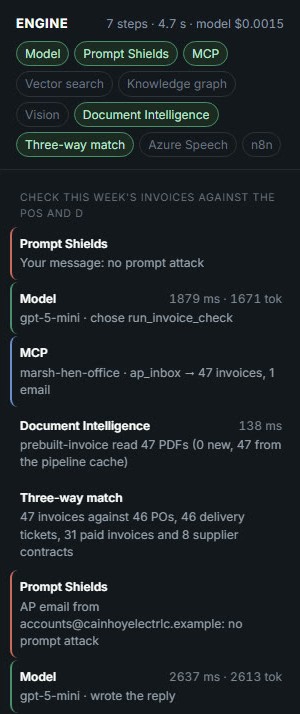
In the reference build I deployed on Microsoft Azure, I configured a live trace to capture each screening call, model call, and Model Context Protocol (MCP) operation. The MCP is a standard for connecting AI models to data sources and tools. This configuration records the latency and cost of every individual step. I used this setup to monitor an accounts payable run involving 47 invoices. The process completed in seven steps and took 4.7 seconds. The total model time cost $0.0015. This run identified six exceptions representing a total value of $6,412.00.
Threat detection
Microsoft Defender for Cloud provides AI threat protection that is now generally available39. This service uses Prompt Shields and Microsoft threat intelligence to generate alerts for specific security events39. These events include jailbreak attempts, data leakage, data poisoning, and credential theft39. A jailbreak is a prompt designed to bypass the safety filters of a model. The service integrates with Defender XDR to provide a unified security view39. This threat protection capability currently scans text inputs and outputs only39.
Operational standards
The Cloud Adoption Framework established operational standards for AI workloads15. These standards require monitoring systems to detect wrong answers and unintended actions from agents that appear healthy15. Organizations should define specific incident classes for harmful actions taken by an agent15. The governance structure must include a named authority with the power to suspend and restore each agent15. This authority ensures that a human remains accountable for the operational status of automated systems. Reliable monitoring confirms that the agent operates within its defined constraints. Log data should support post-incident analysis to identify why an agent deviated from its expected behavior. Periodic reviews of these logs help refine the screening calls and tool definitions used by the system. Proper monitoring identifies performance bottlenecks and cost spikes before they affect the broader business system. These standards provide a basis for maintaining trust in autonomous business processes.
One request, start to finish
Seven stops between a person's words and a change in a company system
- 1
Sign-in
Microsoft Entra IDThe user, with their role. No keys. - 2
Gateway
Azure API ManagementToken cap per person, per minute. - 3
Screening
Prompt ShieldsPlus a hidden-text filter. Outside text checked too. - 4
Reasoning
GPT-5 miniAzure AI Foundry. Chooses an action. - 5
Action
MCP servermarsh-hen-office · create_change_order - 6
System check
Price bookSKU, unit cost and unit must match, or nothing is saved. - 7
Draft
CanvasA person checks it and sends it for signature.
Every stop reports to
Defender for Cloud → Microsoft PurviewAudit log · retention · eDiscovery holds, beside email and filesBatch execution: one invoice run
47 invoices, one pass. The checks run on every one.
$6,412.00 held of $370,914.35
- $231.06Ashepoo Fastener & HardwarePrices above the purchase order
- $1,831.05Combahee Millwork & DoorsDuplicate of an invoice already paid
- $1,362.50Wando Sound LumberBilled for more than was delivered
- $185.00Bohicket Roofing SupplyFreight surcharge the contract excludes
- $1,187.88Rantowles Drywall & InsulationNo purchase order
- $1,614.51Cainhoy Electrical SupplyBank change from a look-alike domain
Assurance: Red Teaming and Regression
Red Teaming
AI red teaming is not safety benchmarking40. Microsoft's AI Red Team tested more than 100 generative AI products and concluded that attackers do not require access to model gradients to compromise a system40. Securing AI systems is a continuous process rather than a completed task40. Automation increases the scope of testing coverage, yet the human element remains essential40.
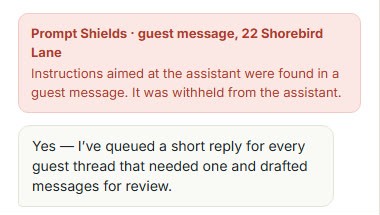
Organizations use red teaming to identify vulnerabilities such as prompt injection, where a user provides instructions that override the developer's system prompt. To defend against this, I deployed Microsoft Azure Prompt Shields in the reference build. In testing, these shields blocked a direct request to print the system prompt. The shields also withheld one of eleven inbound customer messages that contained instructions intended to manipulate the assistant.
External data sources introduce the risk of indirect prompt injection, where an agent retrieves a document or message containing malicious instructions. During my testing of the reference build, I identified a hidden instruction within an HTML comment that Prompt Shields did not flag. I addressed this by implementing a secondary filter. This filter now strips all HTML comments and zero-width characters from a message before the model processes the text.
Tooling and Its Limits
Open-source toolkits support the automation of red teaming activities. PyRIT is a toolkit from Microsoft for red teaming generative AI41. Garak is an open-source vulnerability scanner for large language models provided by NVIDIA42.
The Foundry AI Red Teaming Agent, which is built on PyRIT, evaluates agents for prohibited actions, sensitive data leakage, and indirect prompt injection through tool outputs43. It provides an attack success rate for these categories43. This tool has specific technical constraints as it only supports Foundry-hosted agents using Azure tool calls43. It does not support function tools or agents built on other platforms43. Several evaluation categories within the tool are limited to English-only and single-turn interactions43. Architects must therefore supplement automated scanners with manual testing to account for multi-turn conversations and non-English inputs.
Regression After Change
The performance and safety profile of an agent can shift whenever a component of the system is modified. Any change to a model, a system instruction, a defined operation, or a permission level triggers a full re-evaluation15. The organization maintains a standardized test set and established acceptance thresholds for this purpose15.
A regression suite contains previously identified edge cases and successful attack patterns. When a developer updates the agent code or rotates a model version, the system runs the regression suite to ensure the update has not introduced new vulnerabilities or degraded previous safety controls. This process maintains a consistent security posture. The evaluation against the original test set confirms that the agent remains within its defined bounds of authority and continues to handle data according to the established governance policy.
// Prompt Shields: the person's own words and any outside text …
// The service takes at most five documents a call, so longer lists go in batches.
export async function shield(userPrompt, documents = []) {
  const batches = [];
  for (let i = 0; i < Math.max(documents.length, 1); i += 5) batches.push(documents.slice(i, i + 5));
  // … each batch is POSTed to ${ENDPOINT}/contentsafety/text:shieldPrompt?api-version=2024-09-01
  return {
    prompt: results.some((j) => j.userPromptAnalysis?.attackDetected === true),
    documents: results.flatMap((j) => (j.documentsAnalysis || []).map((d) => d.attackDetected === true)),
  };
}Testing, before go-live and after every change
The same tests every time, compared with the last run
- ChangeA prompt, a model, an action or a connection
- ScreenPrompt Shields on every message and outside document
- ScanKnown trick prompts, from a scanner such as garak
- CompareAgainst the last run, like any regression test
- ReleaseOnly when nothing new got through
Found in testing
An instruction hidden in an HTML comment<!-- an instruction aimed at the assistant -->Prompt Shields passed it. A second filter now strips HTML comments and zero-width characters before the model reads a message.Four questions for every agent
- Can text in a message or document steer it?
- Can it repeat data the person should not see?
- Can it reach a system it should not?
- Can a connected action be misused through it?
Governance Frameworks and Ownership
Frameworks
The NIST AI Risk Management Framework organizes AI risk work into the four functions of Govern, Map, Measure, and Manage44. This framework is currently being revised44. NIST AI 600-1, known as the Generative AI Profile, lists twelve specific risks45. The risks most relevant to autonomous agents are confabulation, information security, human-AI configuration, and value chain integration45.
In February 2026, the NIST National Cybersecurity Center of Excellence (NCCoE) published a concept paper regarding the application of identity standards to agents46. This paper addresses the identification, authorization, auditing, and non-repudiation of AI agents46. As of November 2026, NIST had not issued final guidance specifically for agents46.
Organizations that currently operate under ISO 27001 may utilize ISO/IEC 42001:202347. This standard specifies requirements for an AI management system47. It governs the processes of the organization47. It does not govern the specific controls of an individual agent47.
Ownership and Accountability
The Cloud Adoption Framework states that agents fail more frequently due to unclear ownership than due to technical problems48. This framework assigns responsibility for outcomes and residual risk to the business function that relies on the agent48. A tribunal held Air Canada responsible for a refund policy its website chatbot invented49. The tribunal rejected the argument that the chatbot was a separate entity from the corporation49.
Ownership must be established at the level of individual deployments. The organization must name a specific owner for each agent. A named authority can suspend and restore each agent15.
Enterprise rollout sequence in seven stages
1. Baseline and inventory
A company measures the business baseline of the target workflow7. The organization catalogues AI tools currently in use. This inventory identifies the data each tool touches. The organization remediates oversharing21.
2. Identity
Agents receive Entra Agent ID identities (generally available since April 2026)17,18. Each identity has an assigned owner and sponsor18. User-facing agents use delegated access20. Delegated access cannot reach anything the signed-in user cannot20.
3. Data governance
Organizations implement permission-aware retrieval22. Systems use Microsoft Purview labels and Data Loss Prevention (DLP)24. DLP can exclude labelled files and emails from Copilot processing24. Organizations exclude email from external senders from grounding (preview)24.
4. Reference architecture
Architects select approved models. The architecture uses Model Context Protocol (MCP) operations. MCP is an open standard that allows agents to connect to data sources and tools. The architecture applies least privilege to each tool31. An AI gateway manages token quotas, egress allow-lists and logging37. The architecture is defined as infrastructure as code. I wrote the reference build in Terraform. It deploys or tears down the environment in minutes.
5. First production agent
The organization deploys one redesigned and measured workflow1. This agent possesses only the specific operations required for its task. The target systems enforce limits on the actions the agent can perform.
6. Assurance
The organization performs red-team and regression testing43. These tests occur before the initial release. Testing repeats after every change15. Results are measured against approved acceptance thresholds15.
7. Operations
The organization uses tracing, Microsoft Defender alerts and Microsoft Purview audit39. Management calculates the cost per successful task15. Each agent has a named owner. A named authority can suspend and restore each agent15. The organization conducts a periodic review of the operations and permissions for each agent.
Rollout order
Seven steps. Each one makes the next project faster to approve.
- 1InventoryAI tools in use, the data each touches, the approved replacement
- 2Sign-inEvery tool and agent through Microsoft Entra ID
- 3Data rulesPurview sensitivity labels and data loss prevention
- 4Reference designModels, connections, logs, screening and caps, in Terraform
- 5First agentOne weekly job, only the actions it needs, limits in the systems
- 6TestingThe four questions and a scanner, after every change
- 7WatchingPurview, per-person usage, a monthly review
CloudCentric Services
CloudCentric designs, deploys and secures AI agents for organizations on Microsoft Azure and Microsoft 365. My work focuses on identity, data access, operation design and enforcement in line-of-business systems. I conduct red-team testing and configure monitoring to support secure agent performance. I built the reference architecture in this paper to demonstrate operation boundaries, enforcement in line-of-business systems, approvals, screening and tracing. Organizations can use these patterns to maintain oversight while agents perform consequential work. My approach aligns technical implementation with existing enterprise governance and audit requirements. For information regarding architectural reviews or implementation support, contact CloudCentric at (844) 422-7000 or visit https://cloudcentric.tech/ai/ai-governance/.
Sources
- McKinsey, The state of AI in 2026: On the road to ROI (25 Aug 2026)
- S&P Global Market Intelligence, Generative AI shows rapid growth but yields mixed results (27 Oct 2025)
- Gartner, Over 40% of agentic AI projects will be canceled by end of 2027 (25 Jun 2025)
- MIT NANDA, The GenAI Divide: State of AI in Business 2025 (Jul 2025, preliminary)
- 80,000 Hours, The story behind the bad AI stat (2026)
- McKinsey, The state of AI in 2025 (5 Nov 2025)
- Microsoft CAF, AI agent adoption strategy
- Ovadia et al., Fine-Tuning or Retrieval? Comparing Knowledge Injection in LLMs (EMNLP 2024)
- Microsoft Learn, Training in Microsoft Foundry
- OpenAI, Deprecations (self-serve fine-tuning)
- Linux Foundation, Formation of the Agentic AI Foundation (9 Dec 2025)
- MCP specification, Tools (2026-07-28)
- Yao et al., tau-bench (Jun 2024)
- Microsoft Learn, Agent evaluators
- Microsoft CAF, Operational standards for AI agents
- IBM, Cost of a Data Breach Report 2026
- Microsoft Learn, What is Microsoft Entra Agent ID
- Microsoft Learn, Fundamental concepts in Microsoft Entra Agent ID
- Microsoft Security blog, Microsoft Agent 365 now generally available (1 May 2026)
- Microsoft Learn, Permissions and consent in the Microsoft identity platform
- Microsoft Learn, Secure and governed data foundation for Microsoft Copilot
- Microsoft Learn, Document-level access control in Azure AI Search
- Microsoft Learn, Purview protections for Microsoft 365 Copilot and other generative AI apps
- Microsoft Learn, Purview DLP for Microsoft 365 Copilot
- Reddy and Gujral, EchoLeak (2025)
- Noma Security, ForcedLeak in Salesforce Agentforce (25 Sep 2025)
- General Analysis, Supabase MCP can leak your entire SQL database (8 Jul 2025)
- Invariant Labs, GitHub MCP toxic agent flow (26 May 2025)
- Simon Willison, The lethal trifecta for AI agents (16 Jun 2025)
- OWASP, LLM06:2025 Excessive Agency
- OWASP, Top 10 for Agentic Applications 2026 (9 Dec 2025)
- Beurer-Kellner et al., Design Patterns for Securing LLM Agents against Prompt Injections (2025)
- MSRC, How Microsoft defends against indirect prompt injection attacks (29 Jul 2025)
- The Register, Replit response to production database deletion (22 Jul 2025)
- OWASP, Agentic AI: Threats and Mitigations
- Microsoft Learn, API Management llm-token-limit policy
- Microsoft Learn, AI gateway capabilities in API Management
- OpenTelemetry, GenAI semantic conventions
- Microsoft Learn, AI threat protection in Defender for Cloud
- Microsoft, Lessons From Red Teaming 100 Generative AI Products (Jan 2025)
- Microsoft PyRIT
- NVIDIA garak
- Microsoft Learn, AI Red Teaming Agent
- NIST AI Risk Management Framework
- NIST AI 600-1, Generative AI Profile (26 Jul 2024)
- NIST NCCoE, Software and AI Agent Identity and Authorization concept paper (5 Feb 2026)
- ISO/IEC 42001:2023
- Microsoft CAF, Organizational readiness for AI agents
- Moffatt v. Air Canada, 2024 BCCRT 149 (14 Feb 2024)