Document Data Extraction
One recurring document type, read into fields and checked on one screen instead of retyped.
What this is
Every business has one document that arrives constantly and gets retyped into a system. Invoices, statements, contracts, closing packets, delivery notes, job sheets, applications.
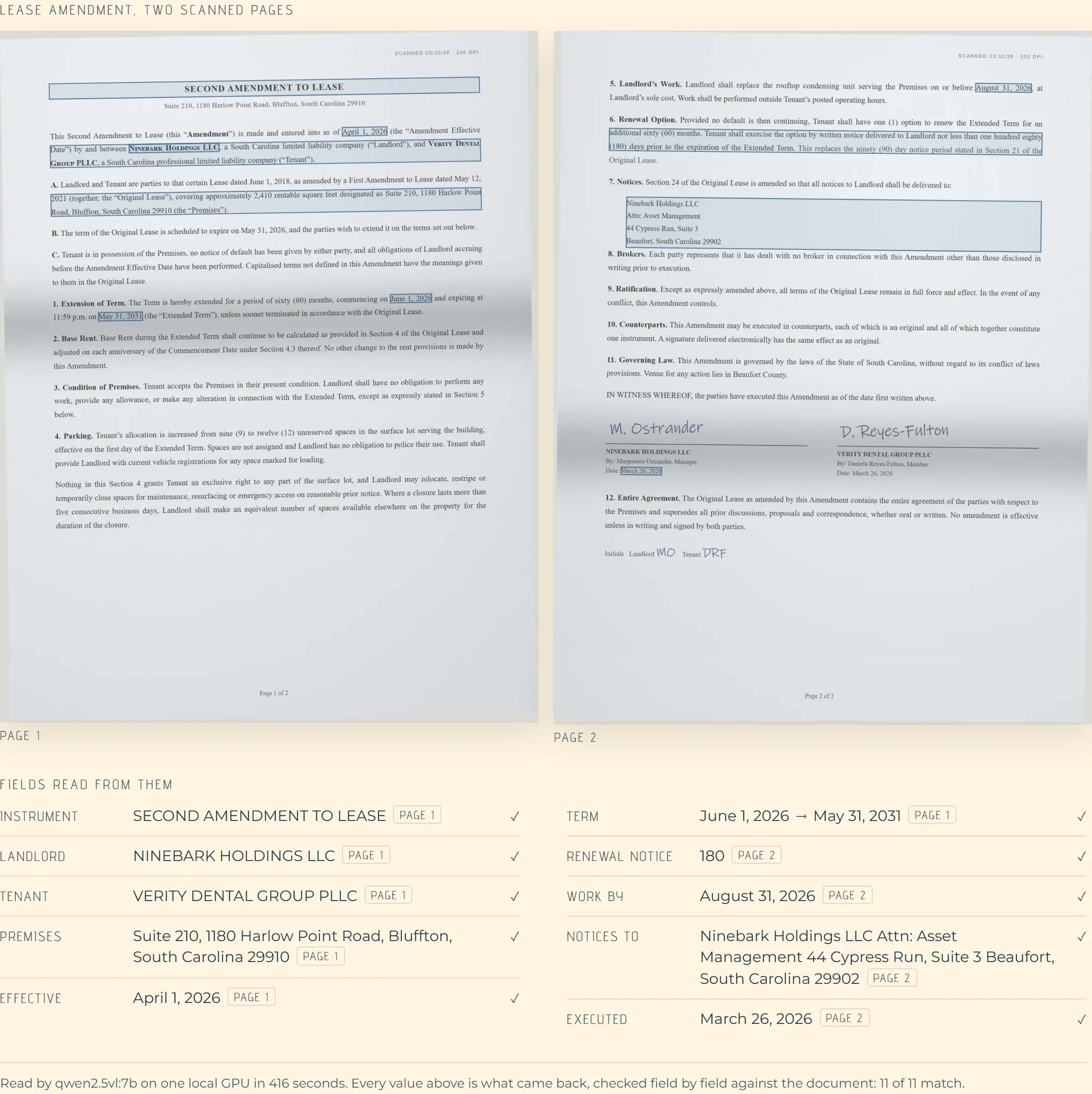
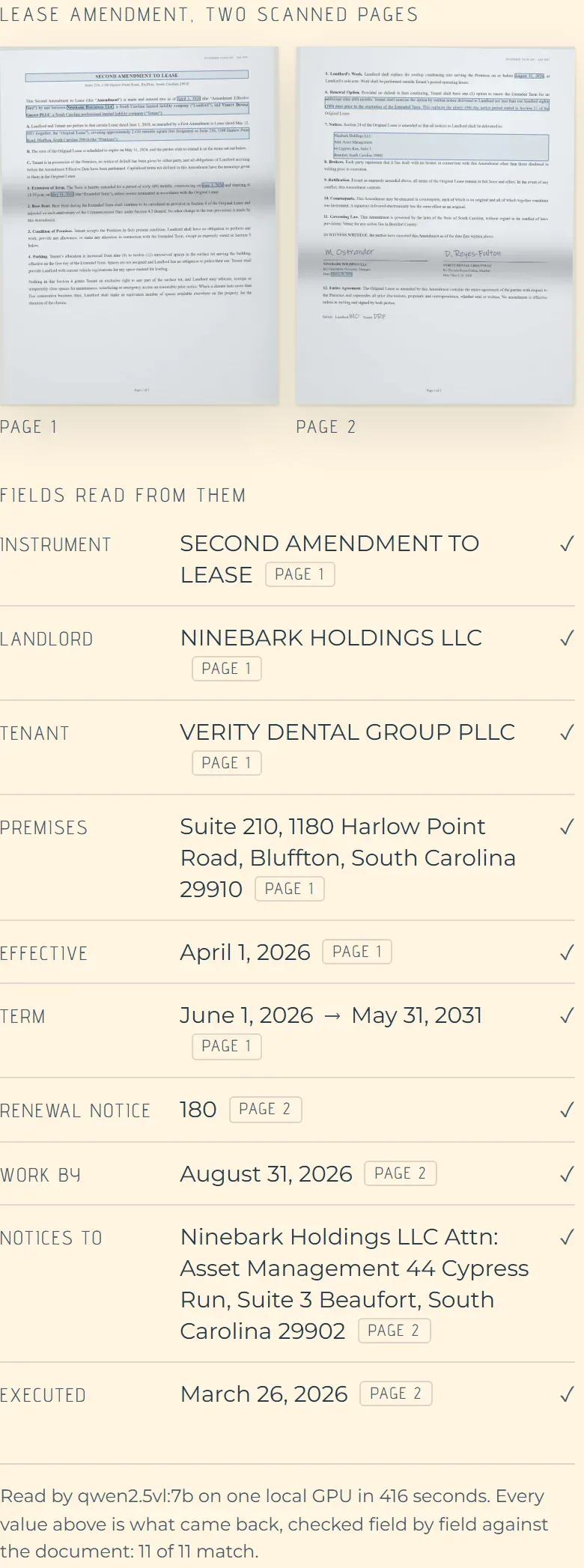
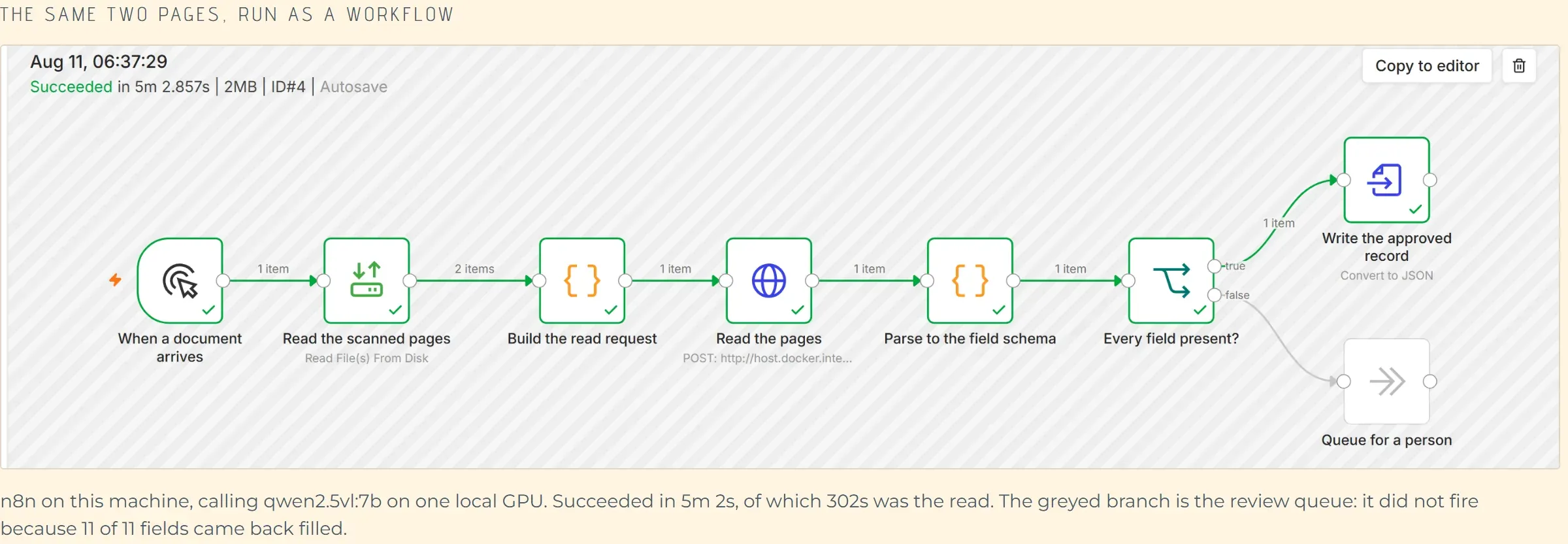
Extraction reads that document into a fixed set of fields, shows a person the result next to the original, and writes the approved record into the system that needed it.
The scope is set by the document type, which is why these projects finish. One document type is a project. Every document type is not.
What you get
What gets built
The build is the schema, the review screen and the write-back.
The field schema
Exactly which fields come out, what each one may contain, and what happens when one is missing.
Extraction that handles the real files
Scans, photographs, sideways pages, stamps written over the total, and the supplier who changed their template without telling anyone.
A review screen
The extracted fields beside the original page, so checking a document takes seconds and corrections are one click.
Write-back to the system of record
The approved record lands in the accounting system, the CRM or the practice system as a proper row.
A confidence threshold
Records the system is sure about move quickly; the rest are queued for a closer look.
A measured accuracy figure
Run against a set of documents whose correct answers are known, so the accuracy number is measured rather than asserted.
How it works
How the work runs
Collect a real sample
A few hundred of the actual documents, including the awkward ones people normally leave out.
Agree the fields
What comes out, and what the system should do when a field is absent or ambiguous.
Build and measure
Extraction is run against documents whose correct values are known, and the result is a number.
Put it in the workflow
The review screen goes to the people who do the job, and the approved records start landing.
In practice
Documents this gets built for
One type at a time. These are the ones that come up most.
Supplier invoices
Header values and line items into the accounting system. The awkward part is line items that break across pages and suppliers who redesign their template without warning.
Contracts and closing packets
Dates, parties, amounts and obligations pulled into a structured record so the same values are not copied by hand into three systems.
Timesheets and job sheets
Often photographed on a phone, on site, at an angle. Testing against real photographs rather than clean scans is the whole difference.
Applications and intake forms
Inbound paperwork that has to become a record before anyone can act on it, with a person approving each one.
What matters
What makes this harder than it looks
The demonstration always works. These are the things that decide whether the production system does.
The awkward documents are the whole job
Clean documents extract on the first attempt. The project is decided by the handwritten annotation, the second page nobody scanned, and the supplier whose layout changed.
Tables are harder than fields
A single value is straightforward. Line items that run across a page break, with a subtotal in the middle, are not.
A person has to stay in it
The output is a reviewed queue, not a decision. Keeping the review fast is what makes the whole thing worth having.
Accuracy has to be measured against known answers
Without a set of documents whose correct values are recorded, there is no way to tell whether a change made things better or worse.
Templates change without notice
Suppliers redesign their paperwork. The system needs to show that something moved rather than quietly extract the wrong number.
The write-back is where the risk is
Reading a document wrong costs a correction. Writing it into the accounting system twice costs an afternoon.
Who it is for
Where this pays
Accounting and bookkeeping
Supplier invoices and statements arriving faster than they can be keyed.
Legal and title work
Closing packets and contracts where the same values get copied into several systems.
Construction and trades
Delivery notes, timesheets and job sheets arriving as photographs from a phone.
Insurance and claims
Claim documentation that has to become a structured record before anything can be assessed.
Questions
Frequently asked questions
How accurate is it?
That depends on the document type and gets measured during the build against documents whose correct values are known. A quoted number before anybody has seen your documents would be made up.
Does someone still have to check the output?
Yes, and that is the design. The system produces a reviewed queue and a person approves the records, which is what keeps it safe to run.
What about handwriting?
Printed and typed text extract well. Handwriting varies enough that it gets tested against your actual documents before anything is promised.
Can it handle more than one document type?
Yes, but they are built one at a time. Each type has its own fields and its own awkward cases.
Where do the documents go?
They stay in storage your company owns. The extraction runs against them in your own cloud account.
How long before it is in use?
A single document type is normally three to six weeks, most of which is spent on the awkward documents rather than the common ones.
Also on this site
Name the document
The one that arrives constantly and gets retyped. That is the place to start.
(844) 422-7000